
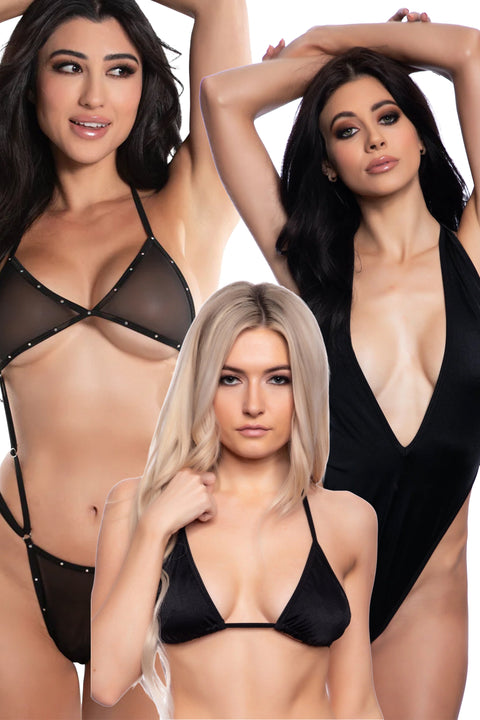
Intro to Dancewear
If you opened your closet right now, you’d instinctively know which pieces of clothing you’re looking at, right? Shirts, pants, dresses…and you could define them even further without thinking twice. Long sleeve vs short sleeve, shorts vs pants, skirt vs dress. Similar silhouettes, different intentions.
Dancewear works the same way. From a distance, it’s easy to lump everything together and call it a “bikini” or a “one-piece”, but much like your closet, there are differences between the styles. They’re just not as obvious as short vs long sleeve shirts.
Because we want you to be informed about the sexy dancewear you put on your body, we’re breaking it down to teach you the differences between dancewear tops, dancewear bottoms, and dancewear one-pieces.
On a basic level. We’ll go deeper another night.
Scroll down to learn more about the different types of dancewear.
Defining Dancewear Tops
Dance tops tend to trip people up the most. Not because they’re complicated, but because there are a lot of variations. Small changes in shape and coverage can turn one top into something entirely different.
To keep things simple, here’s a breakdown of our three main dance top styles:
-
Tri Top - The classic bikini top. The “tri” is just a shortened version of “triangle”, because the top is essentially two triangular pieces of fabric tied together. She’s a necessity and a chameleon, aka the straps can be worn in various ways to switch up and fit any look.

-
Bandeau - More coverage than a tri top, but easier to maneuver on and off. This one-piece top is the scandalous sister of the tube top, with a strapless design and slimmer cut.

-
Crop Top - The favorite style reimagined for the stage. Our crop tops are basically cropped tank tops or halter tops, with a form-fitting silhouette, thin straps/high neck, and a high cut bodice. An easy, sexy piece that’ll move with the body.


You’ve most likely seen variants of these tops in the wild — like micro tri tops, cut-out/cage bandeau tops, and crop tops with varying levels of strap thickness. Once you know what you’re looking at, it’s easier to choose which style works best with your outfit and vibe.
Defining Dancewear Bottoms
Dance bottoms are usually the easiest to tell apart, mostly because their designs mirror regular panties. The difference is the intention. These are crafted with a stronger structure and with performance in mind.
Here’s a breakdown of our five main dance bottom styles:
-
Thong - Thongs are minimal by design. Cut to sit comfortably on the hips, they highlight the natural curves with barely-there coverage.

-
Scrunch Back - A flattering way to draw booty attention without showing everything off, scrunch back bottoms give that classic bikini fit with a gathered back. The scrunch enhances the shape and gives a little definition.

-
Booty Shorts - Booty shorts are the bold sister of the boyshort. Low-rise, thicker through the front, and cut high in the back, they blur the line between bikini and shorts for a cheeky, sexy fit.

-
Boyshorts - Out of all the panty-inspired designs, the boyshort will provide the most coverage. It’s cheeky, a little sporty, and sits comfortable on the hips. They offer ease of movement without sacrificing sex appeal.

-
Dolphin Shorts - A daring version of the retro dolphin short, these athletic-inspired bottoms are cropped short, have a curved side, and are designed to show leg. They’re playful and flirty, and completely redefine the wearer’s aesthetic.

Each style can come in varying degrees of thickness/coverage and feature added details like garter straps, but they all start with one of our main bases as their flirty foundation. And once you understand your base, you can build the rest of your look.
Defining Dancewear One-Pieces
Moving on from dancewear separates, one-pieces have become a hot topic of conversation. You probably know what a bodysuit looks like, but we break our one-pieces down further based on structure and fit.
Here’s a breakdown of the four distinct styles we use to create our one-piece dancewear:
-
Monokini - A monokini is a one-piece illusion. It’s a single silhouette that, at a glance, looks like a bikini, but is designed with a sexy, strappy bodice that connects it all. All the fantasy of a bikini, stitched into one seamless look.

-
Romper - Rompers are the soft, sensual cousin of the bodysuit. Typically sheer with comfortable hip coverage, they lean into the lingerie realm with their romantic cuts and effortless energy. An easy way to create an instantly flirty, feminine look.

-
Bodysuit - An icon. A classic. Bodysuits are one-piece styles that offer more structure, coverage and definition, designed to hug and highlight the body in all the right places.

-
Sling - Pure seduction with minimal coverage. A sling is designed to create a striking V-shape on the front and back of the body. Deep cut, high cut, strappy, and incredibly sexy.

The difference between these silhouettes comes down to structure and coverage. Bodysuits offer the most of both, rompers provide lighter coverage, monokinis keep things minimal, and slings cover just enough with their signature V-cut shape. It all comes down to how much structure you want to work with.
Congrats, You’ve Passed Dancewear 101
Now that you know the basics, it’ll be easier to spot the styles you already love and the ones worth experimenting with. We’ll educate you further another night.